Every leader has been there. A restructure is announced, a new system is rolled out, a culture shift is underway, and the reaction in the room is anything but enthusiastic.
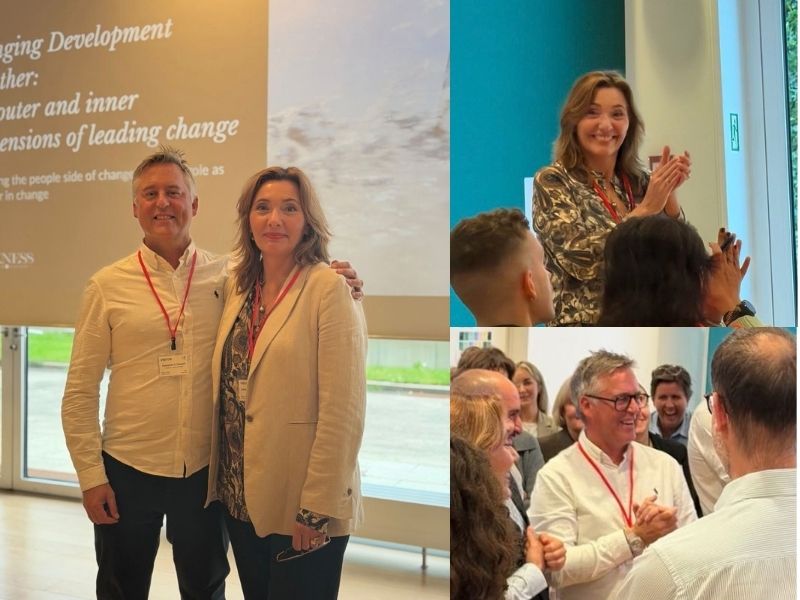
Recently, together with my partner Carla Packness, I ran a session in Copenhagen for a global pharmaceutical company, called “Bringing Development Together: The Outer and Inner Dimensions of Leading Change”. It brought together some of the ideas we come back to most often. Here are five of them.
1. The brain reacts to uncertainty before it reacts to opportunity
When we face uncertainty, the brain becomes hypervigilant. It scans for threats first. This is why change so often triggers a stress response before it triggers curiosity, and why telling people to “be positive” rarely works. Leaders who understand this stop taking the initial reaction personally and start designing for it.
2. We have a love and hate relationship with change
Change is an opportunity to grow, innovate and break old patterns. It also upsets routines, demands effort and can threaten the relationships and certainty we value. Both feelings are true at the same time, often in the same person. Acknowledging both is more credible than pretending only the first exists.
3. The world shapes how we experience change
For years, leaders described their environment as VUCA: volatile, uncertain, complex and ambiguous. The term comes from the military world. More recently, futurist Jamais Cascio proposed BANI, which describes how that environment feels from the inside: brittle, anxious, non linear and incomprehensible.
Our own shorthand for what leadership requires today is REID:
- Resilience
- Empathy
- Improvisation
- Diversity of thought
4. Change has a cycle, and so do emotions
Change moves through recognisable stages: being “in the dark”, seeing the challenge, getting started, rolling out, and finally reaching results and anchoring them. Alongside this runs an emotional journey that many leaders will recognise:
“I’m right behind you.” “I don’t get it.” “I don’t like it.” “I don’t like you.”
The last one is said with a smile in the room, but it captures something real. When change goes badly, people stop objecting to the plan and start objecting to the person leading it.
5. Resistance comes in different forms
Not all resistance is the same, and each type needs a different response:
- Expectations: people fear what will be asked of them.
- Cognitive: people don’t understand the reasons or the logic.
- Emotional: people feel loss, worry or anger.
- Relationship and trust: people doubt the intentions or the credibility of those leading.
Explaining the strategy again will not help someone whose resistance is emotional, and reassurance will not help someone who simply needs the logic.
From models to practice
Models are only useful if leaders apply them to their own reality. In Copenhagen, participants mapped who was being impacted by change in their own organisation, and at what level of resistance. They plotted real colleagues onto the change cycle.
That exercise is where the shift happened. The conversation moved from “why are they resisting?” to “what is my role in this?”. The most valuable moment was seeing leaders look honestly at their own part in leading change, not just managing it.
Leading change well
Leading change is both an outer and an inner task. The outer dimension is the plan, the communication and the structure. The inner dimension is how people, including the leader, experience and make sense of what is happening. Leaders who work on both create change that lasts.
Is your organisation navigating change right now? Whether it is a restructure, a new system, a culture shift or simply preparing your leaders for what is next, we would love to help you explore the outer and inner dimensions of leading it well. Get in touch with us to talk about running a session like this for your team.
Live Learning, rethinking the way we learn!