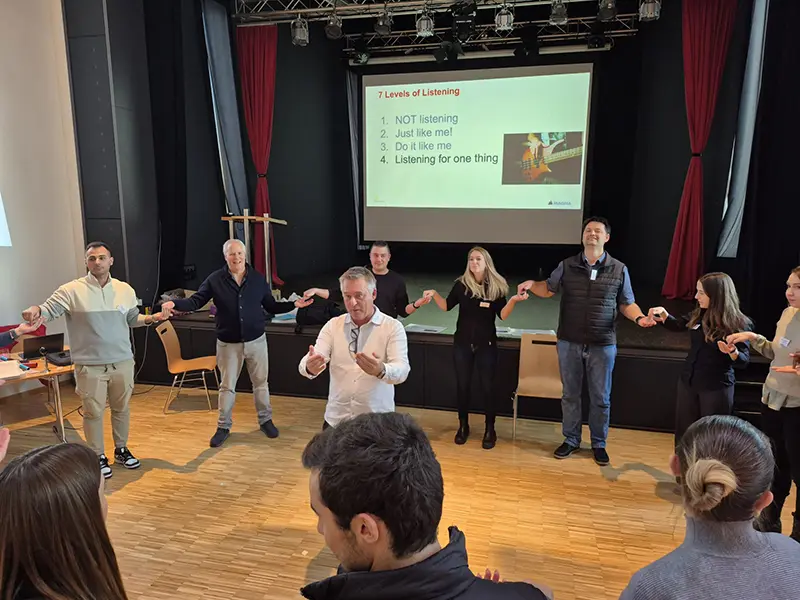
This is one of the core values of Live Learning, and progress doesn’t come from knowing more, it comes from doing more.
We’ve all seen it: Insight sparks interest. Interest creates intention. But practice is what creates change.
The Knowing-Doing Gap
Most learning programs are designed around knowledge transfer. Slides, videos, reading materials, they inform. But information alone rarely shifts behaviour. There’s a well-documented gap between what people know and what they actually do when they’re back at their desk, in a meeting, or leading a difficult conversation.
The only way to close that gap? Repetition in realistic conditions.
Why Live Practice Works
Live practice is where confidence comes alive. When people test ideas in real time, try new behaviours, and reflect in the moment, learning stops being theoretical and starts becoming transferable.
Mistakes aren’t failures, they’re data. Feedback isn’t judgment, it’s fuel.
That’s why “Practice Makes Progress” isn’t a slogan. It’s a design principle.
✔ Less passive listening
✔ More real scenarios
✔ More rehearsal, reflection, and repetition
What This Looks Like in Practice
Here are four ways to bring this principle to life, whether you’re designing a learning experience or simply trying to grow a new skill yourself:
1. Replace review with rehearsal. After learning something new, don’t just re-read your notes. Find a low-stakes opportunity to actually use the skill, a team meeting, a peer conversation, a role-play with a colleague. Doing beats reviewing, every time.
2. Make feedback a habit, not an event. Don’t wait for a formal review to find out how you’re doing. Ask for micro-feedback after key moments: “What landed well? What could I do differently?” Short, frequent feedback loops accelerate progress far more than annual reviews.
3. Embrace imperfect attempts. The biggest barrier to practice is the fear of not getting it right. Shift the internal measure from “Did I do it perfectly?” to “Did I try it?” Progress lives in the attempt, not the result.
4. Reflect, then repeat. After each practice moment, take 60 seconds to ask yourself: What worked? What felt uncomfortable? What will I do differently next time? That brief reflection is what transforms experience into learning.
Progress Over Perfection
Because progress isn’t about perfection, it’s about momentum.
If learning is meant to create impact, then practice isn’t optional. It’s the point. The organisations that grow fastest aren’t the ones with the best content libraries, they’re the ones that create the most opportunities for people to practise, stumble, reflect, and try again.
That’s the Live Learning way.
Ready to build a learning culture built around practice? Get in touch with our team.